Guides · EMD and money
After you win a GeM bid: getting paid on time, funding the order, and turning it into proof
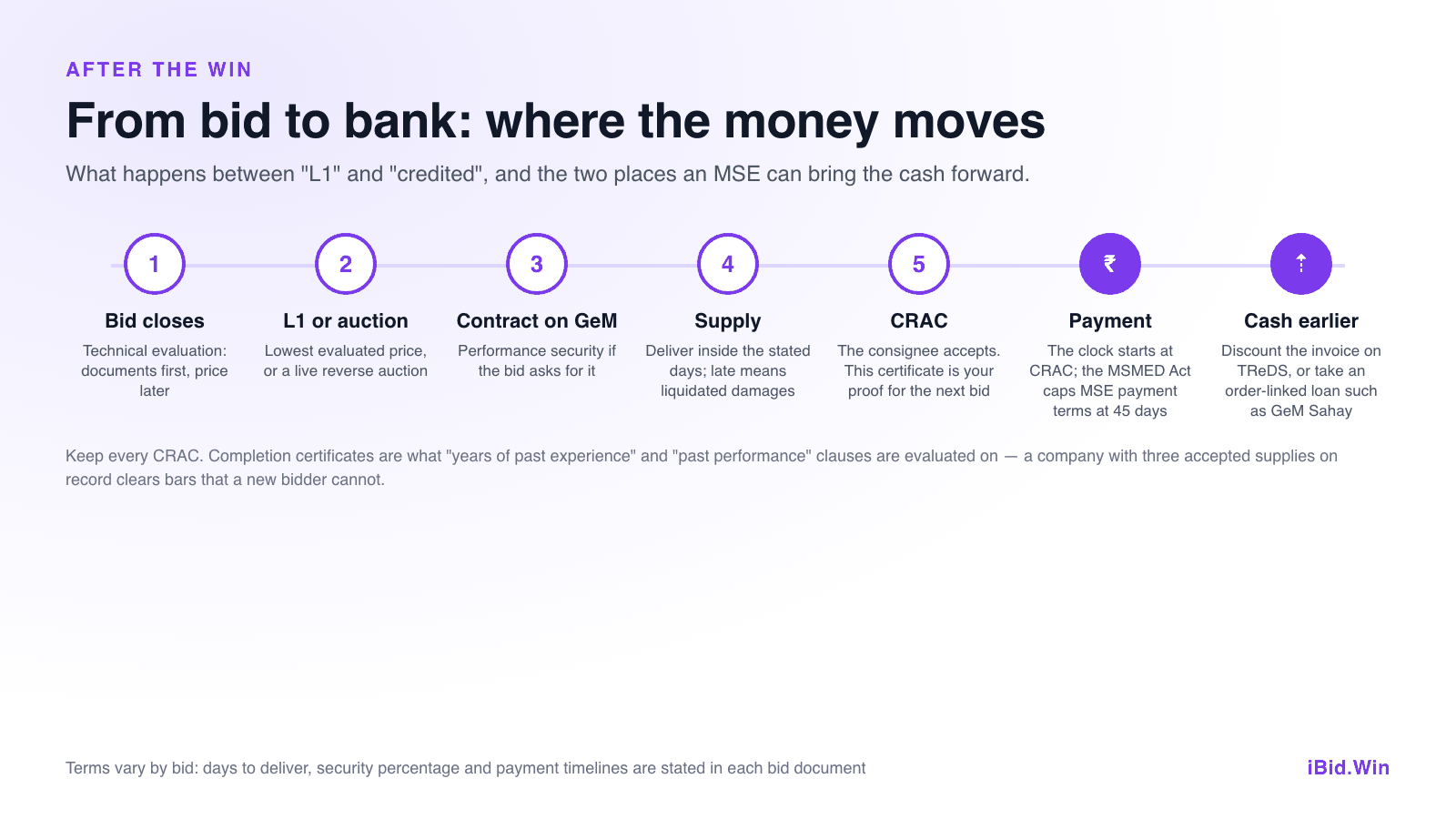
Winning is the middle of the story. The payment clock starts when the consignee accepts the delivery and issues the CRAC; the MSMED Act caps an MSE's payment term at 45 days, with interest for delay. Before the government pays, the invoice can be discounted on TReDS or the order can back a loan such as GeM Sahay. And the acceptance certificate itself is the proof that clears the experience bars on the next, larger bid.

What "won" actually triggers
The award becomes a contract on GeM. If the bid asked for performance security, it is furnished now, as a bank guarantee or an ePBG, at the percentage the bid stated. The delivery period in the bid starts running, and late delivery attracts liquidated damages at the rate written in the terms. None of these numbers is fixed across bids. Read your own contract, not a friend's.
The payment clock, and who set it
You deliver. The consignee inspects and accepts, and GeM records a Consignee Receipt and Acceptance Certificate, the CRAC. That certificate is the moment the payment clock starts, and each bid document states how many days the buyer has after it.
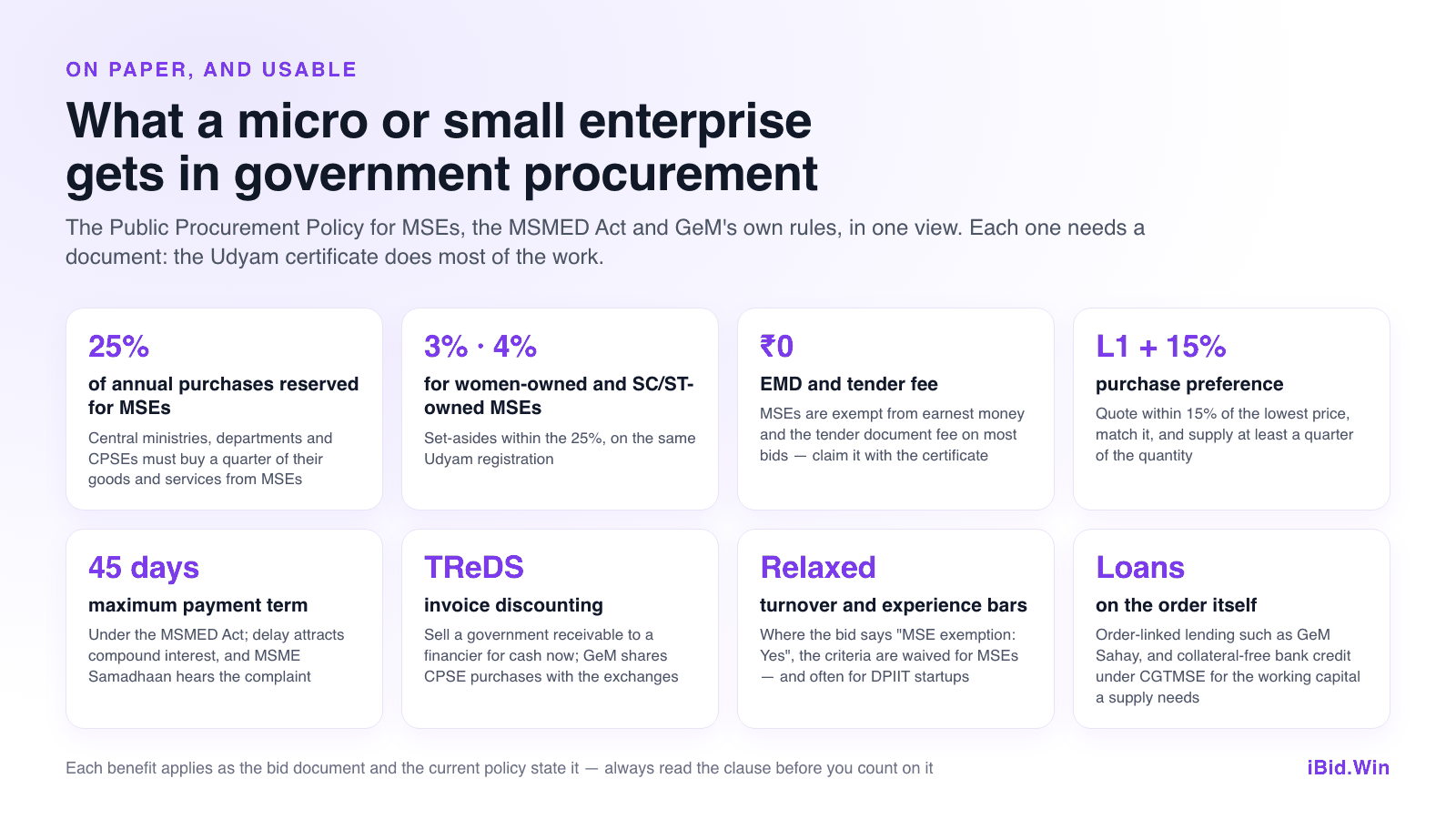
Behind the bid sits the law. The MSMED Act caps the payment term a buyer may agree with a micro or small enterprise at 45 days from acceptance, and a buyer who pays late owes compound interest on the delay. If a payment stalls, the MSME Samadhaan portal takes the complaint to the state's Micro and Small Enterprises Facilitation Council. Most MSEs never need it, but it is why the government is, on paper, one of the most reliable payers a small firm can have.
Cash before the government pays
Two mechanisms exist so that a small supplier does not have to fund a government order out of its own pocket for a month or two.
- TReDS, invoice discounting. The Trade Receivables Discounting System is a set of RBI-regulated exchanges where a supplier sells an accepted government or corporate invoice to a financier and gets most of the money now. GeM itself is linked with the TReDS exchanges so that CPSE purchases from MSEs can be shared with financiers. Large companies and CPSEs are required to be on it; a supplier registers once.
- A loan against the order. Order-linked lending, such as GeM's own GeM Sahay channel, offers working capital at the point of accepting a GeM order, through the lenders active on the platform at the time. Outside GeM, the CGTMSE guarantee lets banks lend to MSEs without collateral up to a ceiling that has been raised in recent years, and most banks will sanction a limit against a government purchase order.
Which of these fits depends on the order size and your bank. What they have in common: a government contract is bankable paper, and a new MSE should treat it that way from the first win.
Every accepted supply is an asset you keep
Look at the eligibility lines on the next bid you open: "Years of past experience required", "Past performance". Those clauses are evaluated on completion certificates and accepted supplies, and a CRAC from a government consignee is exactly that. Three accepted supplies on record clear bars that a new bidder cannot, and they let you bid for larger quantities and higher-value categories where competition is thinner.
So file every CRAC and work order the day you get it. On iBid.Win the Company Portfolio reads them, records the buyer, value and date, and marks the contract "proven", so the next bid's experience clause is answered from documents rather than from memory.
The preference that grows with you
The MSE benefits do not switch off after the first win; they compound. Buyers must place 25% of their annual purchases with micro and small enterprises, and a supplier with a track record is the easy way for them to meet it. The purchase preference lets an MSE that quotes within 15% of the lowest price match it and take at least a quarter of the quantity. Women-owned and SC/ST-owned MSEs have their own set-asides inside that 25%. A firm that has delivered twice is the one buyers remember when the next bid is drafted.
Four traps after the win
- The delivery date is the delivery date. Liquidated damages are deducted from the payment, not invoiced later; a week late can cost more than the margin.
- Acceptance is not automatic. A consignee can reject on specification. Supply exactly what was quoted, with the test reports the bid asked for.
- The security is real money. A performance guarantee is forfeited on non-performance; keep the bank informed of your delivery schedule.
- Invoice hygiene. A GST invoice that does not match the contract line items delays the CRAC, and the CRAC is the clock.
Where this comes from
Policy facts are from the MSMED Act 2006, the Public Procurement Policy for MSEs and GeM's published terms; the figures in the graphics are the August 2026 count from iBid.Win's mirror of GeM. Every contract is different; the bid document and gem.gov.in are the authority on days, percentages and conditions. The EMD exemption guide and the bid security versus performance security guide cover the money on either side of the award.
Frequently asked
How fast does the government actually pay?
The bid document states the days after CRAC, and the MSMED Act sets 45 days as the outer limit for an MSE. In practice the delay is usually in getting the CRAC issued, not in the payment after it, which is why the invoice and delivery paperwork matter more than follow-up calls.
Can I discount a GeM invoice if my buyer is a ministry rather than a CPSE?
TReDS onboarding of government departments varies; CPSEs and large companies are the reliable cases. A purchase-order-backed limit from your bank is the alternative.
Does one win make me eligible for everything?
No. Each bid sets its own experience and turnover bars; one accepted supply of ₹9 lakh will not satisfy a clause asking for three works of ₹50 lakh. It will satisfy the many bids that ask for one similar supply, which is where the second win comes from.
Last checked 08 September 2026. Written from GeM's published process and this platform's own rules; the bid document and the GeM portal are the authority on any date or amount.