Guides · Getting started
The government buys in small lots: how a new MSME starts selling on GeM
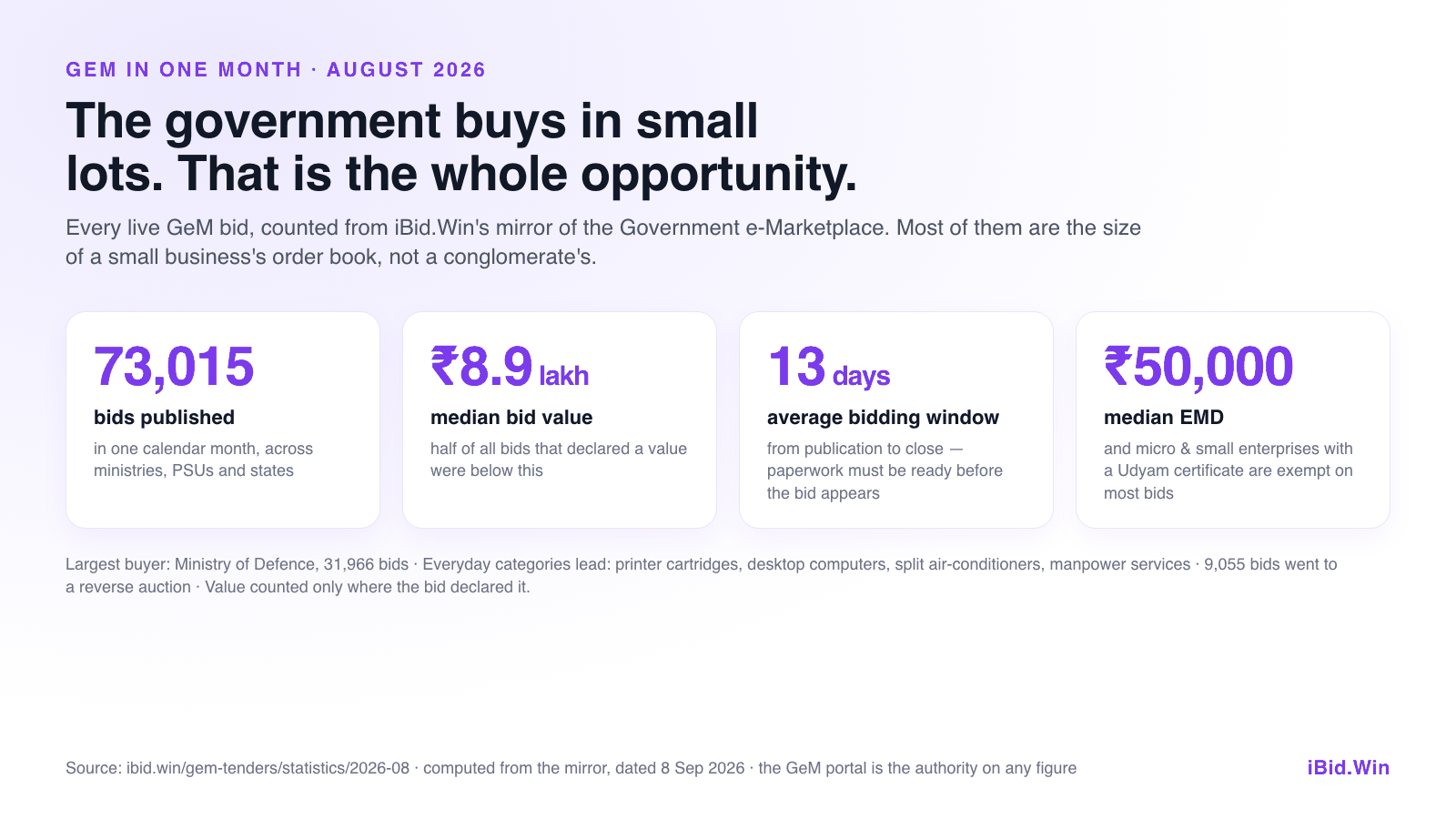
In August 2026 the Government e-Marketplace published 73,015 bids, and half of those that declared a value were under ₹8.9 lakh — the size of an order a ten-person firm fills in a fortnight. Central ministries must buy through GeM whatever is available there, a quarter of public purchases is reserved for micro and small enterprises, and an MSE with a Udyam certificate bids without earnest money. Six steps, all free or nearly free, take a company from never having bid to a submitted bid.

Why every ministry is on GeM now
GeM went live in August 2016 as a website where government buyers and private sellers meet. What turned it from a website into a market is one rule. Rule 149 of the General Financial Rules makes it mandatory for central ministries and departments to buy goods and services that are available on GeM through GeM, and the Department of Expenditure has kept reminding them of it in circular after circular. Most state governments have signed on as buyers too. The practical result: an officer who wants printer cartridges, desktops, air-conditioners, security staff, vehicles or a survey done cannot quietly pick a vendor any more. The requirement is posted as a bid, and anyone registered can quote.
That is why the categories at the top of the August count are so ordinary. Toner cartridges. Entry-level desktops. Split air-conditioners. Manpower services. Goods tricycles. The Ministry of Defence alone published 31,966 bids in the month, and most of them were for things a small supplier already sells.
The rules are written in your favour, not against you
Government procurement in India has a set-aside for micro and small enterprises, and it is not a slogan. Under the Public Procurement Policy for MSEs, central ministries, departments and public sector companies must buy 25% of their annual purchases from micro and small enterprises, with 3% of that from women-owned and 4% from SC/ST-owned MSEs. Buyers report against that number, which is why so many bids carry an "MSE exemption" line.
What the exemption does on a GeM bid, in plain terms:
- No earnest money. MSEs with a valid Udyam certificate are exempt from the EMD on most bids. The median EMD in August was ₹50,000, so on a ₹9 lakh order that is real working capital kept in your account.
- No tender fee for the document.
- Purchase preference. If your quote is within 15% of the lowest price, you can match it and supply at least a quarter of the quantity.
- Relaxed bars. Where the bid says "MSE exemption for years of experience and turnover: Yes", those criteria are waived. DPIIT-recognised startups get similar relaxations on many bids.
Every one of these is claimed with a document, uploaded with the bid. None of them is automatic. That is the first thing a new bidder learns, usually the hard way.
Six steps from "never bid" to "bid submitted"
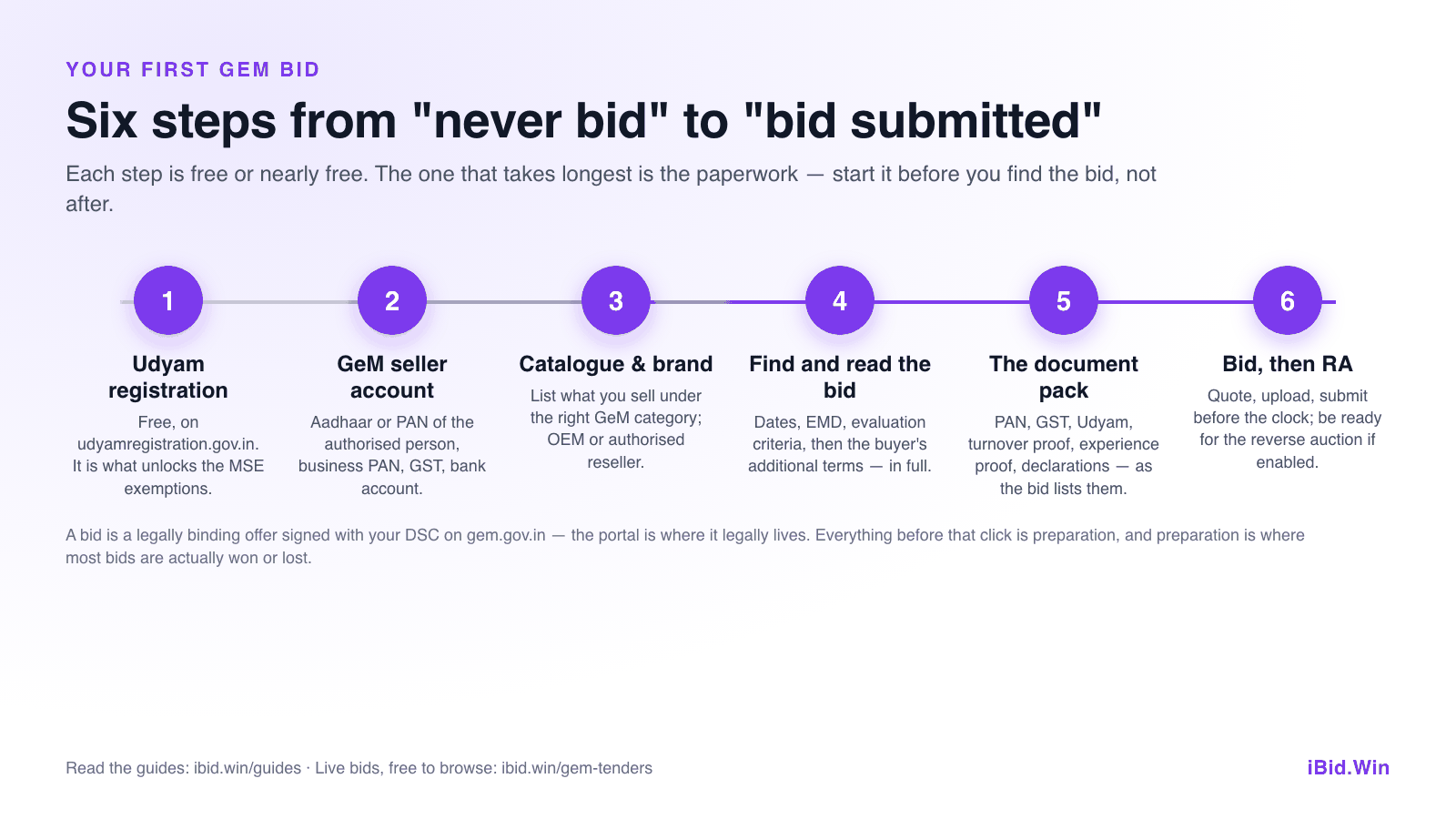
- Udyam registration. Free, online, in under an hour. It is the certificate every MSE benefit is claimed with, so do it first.
- A GeM seller account. The authorised person's Aadhaar or PAN, the business PAN, GST and bank details. Also free.
- Your catalogue. List what you sell under the right GeM category, as an OEM or as an authorised reseller with the manufacturer's authorisation on file.
- Find the bid and read it in the right order. Dates and EMD first. Evaluation criteria second. The technical specification third. The buyer's additional terms last, and in full, because that is where the surprises live.
- The document pack. PAN, GST, Udyam, turnover proof, experience proof and the declarations the bid names. Build the list from the bid, not from memory.
- Bid, then the auction. Quote, upload, submit before the clock. If the bid is "Bid to RA", the price is settled in a live reverse auction afterwards: decide your floor before it starts.
The average window from publication to close in August was 13 days. The paperwork takes longer than that the first time, which is why the document pack should start before the bid is found.
The three mistakes that end a first bid
A mismatch between documents. A GST certificate in the proprietor's name and a bid submitted by the private limited company is a rejection, not a clarification. Every document must name the same entity, with the same PAN.
An exemption claimed without its certificate. Ticking "MSE" and not attaching the Udyam certificate is the most common way to lose the EMD exemption, and sometimes the bid.
The additional terms, unread. Buyers add clauses: a completion certificate for similar supply, a specific test report, a site visit. They are in the ATC, they are binding, and they are the reason a standard checklist is never enough.
What it costs to start
Udyam is free. The GeM seller account is free. A Class 3 digital signature certificate from a licensed certifying authority is a small annual cost. The EMD is exempt for an MSE. The real cost is time: the first document pack, done properly, is a week of an owner's attention. The second one is a day.
Where the numbers come from
The figures are computed from iBid.Win's mirror of GeM for August 2026 and dated 8 September 2026. Policy facts are from the General Financial Rules, the Public Procurement Policy for MSEs and GeM's published process. Every bid is different; the bid document and gem.gov.in are the authority on any date, amount or condition. Every live GeM bid is free to browse at ibid.win/gem-tenders.
Frequently asked
Can a brand-new company bid, with no past supplies?
Yes, on bids that grant the MSE or startup exemption from experience and turnover criteria, and on bids that set no such bar. Read the 'Years of past experience' and 'MSE exemption' lines on each bid before spending time on it.
Do I need to be near the buyer?
No. GeM bids are national; the consignee's location only matters for delivery cost and time, which you price in.
Where does the EMD money go when I lose?
Back to you. Earnest money is returned to unsuccessful bidders; it is a deposit, not a fee. As an MSE with a Udyam certificate you usually do not pay it at all.
Last checked 08 September 2026. Written from GeM's published process and this platform's own rules; the bid document and the GeM portal are the authority on any date or amount.